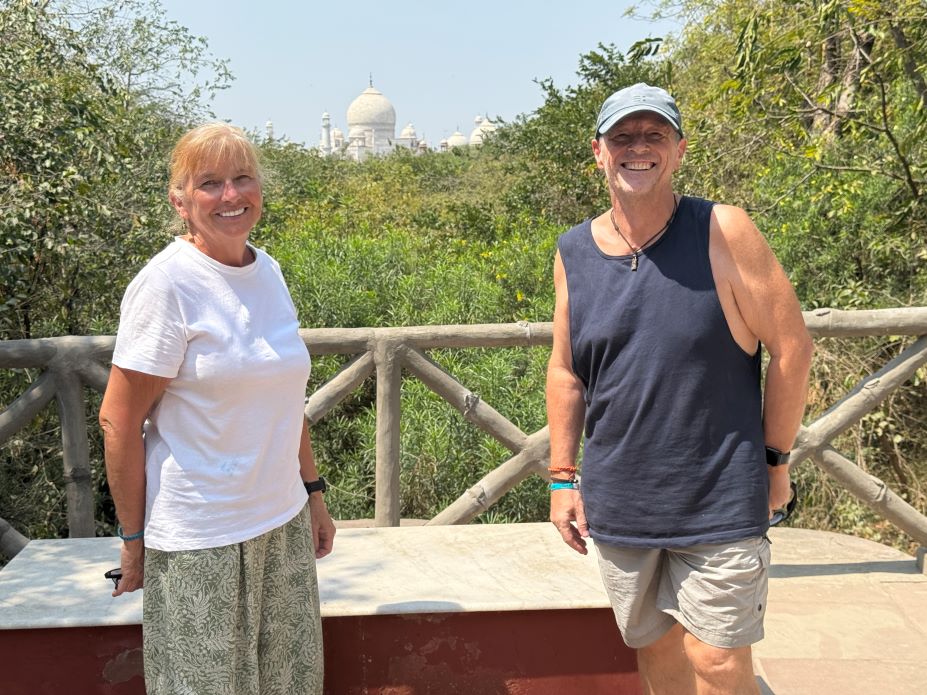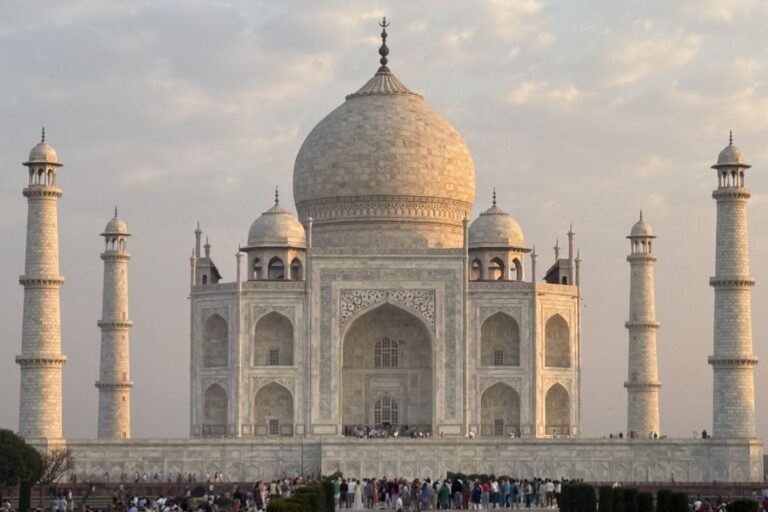
The ancient city of Agra is situated on the banks of the Yamuna River, 230 kilometres southeast of Delhi. It is home to the iconic Taj Mahal, a stunning mausoleum built by Mughal ruler Shah Jahan in memory of his wife, Mumtaz Mahal. The city is also renowned for other Mughal-era buildings, such as Agra Fort and Fatehpur Sikri, all of which are UNESCO World Heritage Sites. On the downside, Agra city can be described as a frenetic, polluted, and dirty city, characterised by crumbling pavements and a higher number of stray animals than we’ve seen elsewhere in India. This was Terry’s third visit to the Taj Mahal (he visited in 1992 and 2010), and each time, the monument took his breath away. On this trip, we both agreed that the Taj Mahal alone at sunrise was worth shuffling along with the crowds of tourists and navigating through the city’s chaotic, congested traffic.
Although Agra boasts some spectacular structures, it has experienced a turbulent history. Founded in 1504 by the Muslim ruler Sultan Sikander Lodi, the city was established after he sailed down the Yamuna River from Delhi, searching for a suitable capital for his sultanate. Agra flourished until 1526, when its successor, Ibrahim Lodi, was defeated by Babur, marking the beginning of the golden age of the Mughal era. The magnificence of Agra peaked from the mid-1500s to mid-1600s, during which many of the famous structures seen today were constructed. Throughout history, the Mughal Empire alternated its capital between Agra and Delhi several times until Aurangzeb, the son of Shah Jahan (the Emperor who commissioned the Taj Mahal), usurped his father and imprisoned him in Agra Fort. He spent his remaining days watching the completion of the Taj Mahal from his prison and gazing at his beloved wife’s mausoleum, never allowed to enter it.
Our Agra Highlights
With so many special sights to see, we decided to spend two and a half days in Agra, which included a sunset tour of the Taj Mahal and Agra Fort. Since the Taj Mahal is closed on Fridays, we had the opportunity to use that day to explore some of the city’s lesser-known attractions, including the lively bazaars in the streets surrounding the Old Town. We also enjoyed watching the sunset over the Taj Mahal from the banks of the Yamuna River – a rare treat indeed!
I’timād-ud-Daulah – The Baby Taj
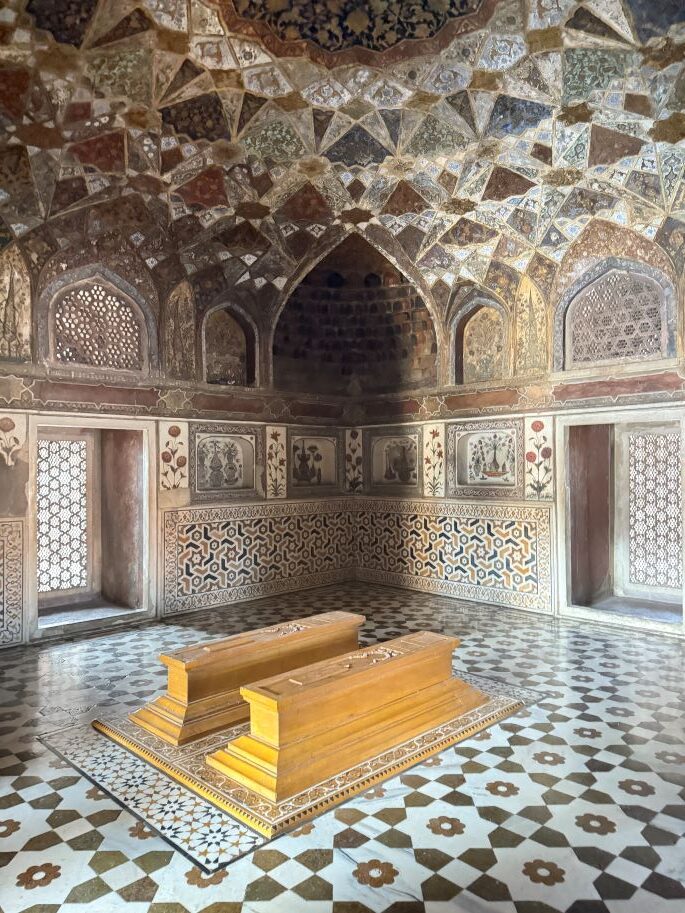
As we approached our first attraction, I’timād-ud-Daulah, the condition of the pavements and roads significantly improved. Built in the early 17th century, this exquisite marble mausoleum, set within a beautiful garden, contains the tomb of Mirza Ghiyas Beg, who was honoured with the title I’timād-ud-Daulah (Pillar of the State) by Mughal Emperor Akbar for being a successful businessman and a servant in the court and for producing successful offspring who served as generals for successive Mughal Emperors.
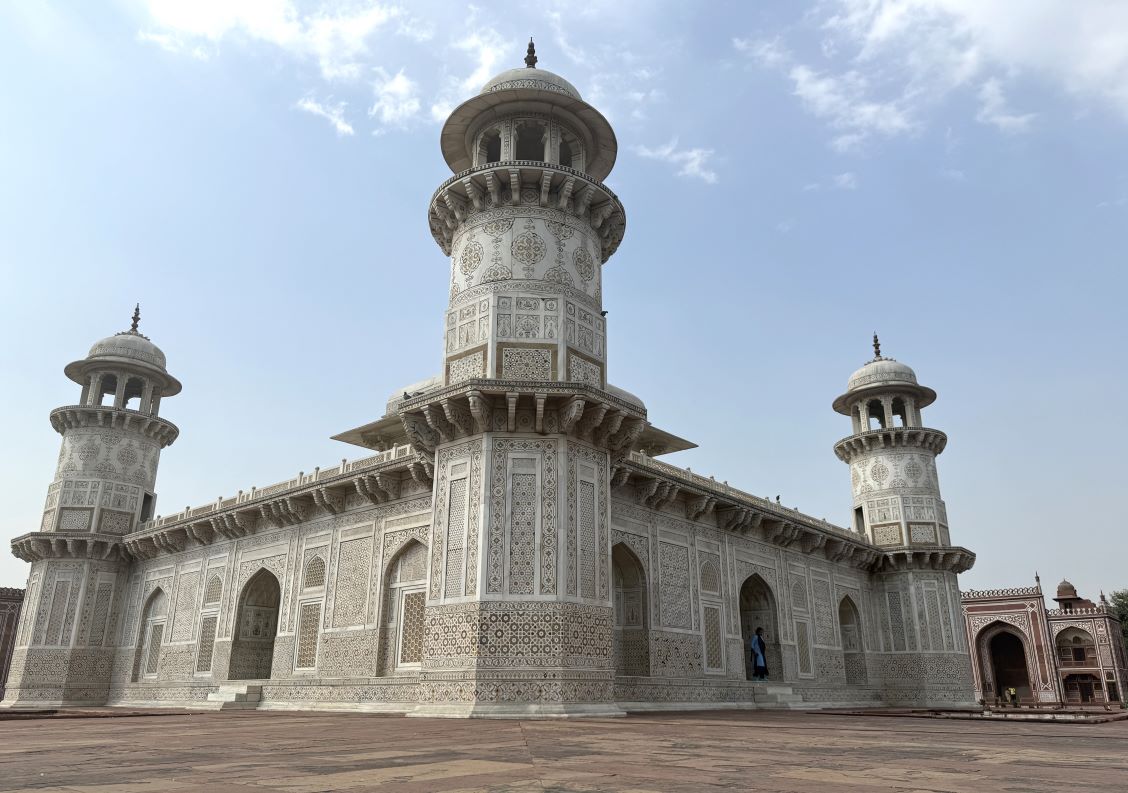
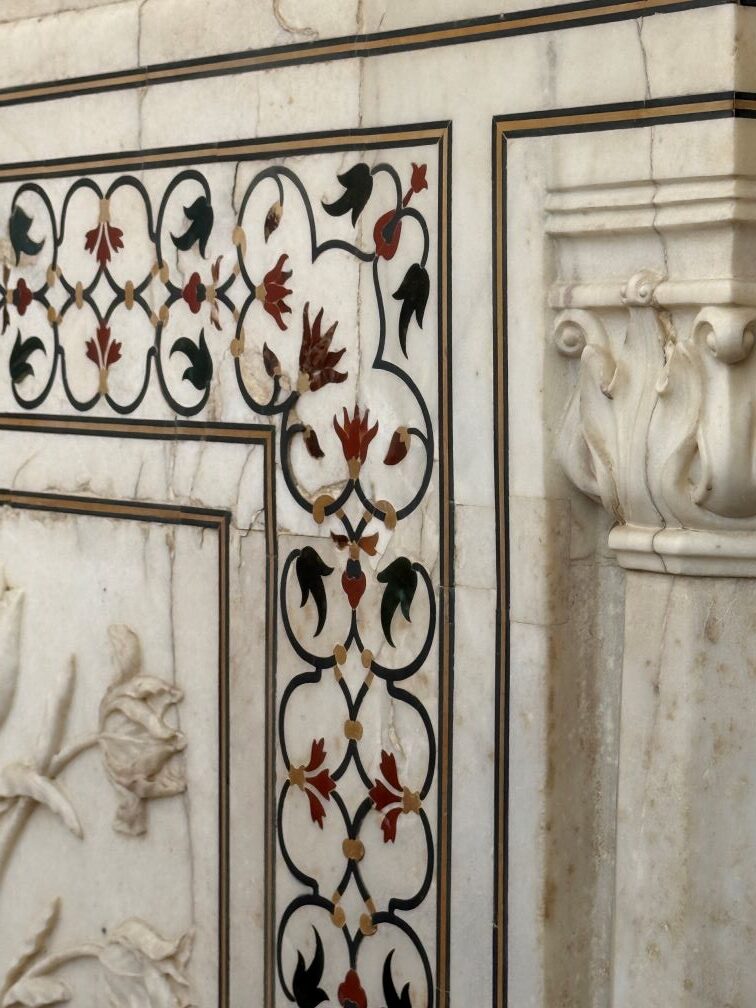
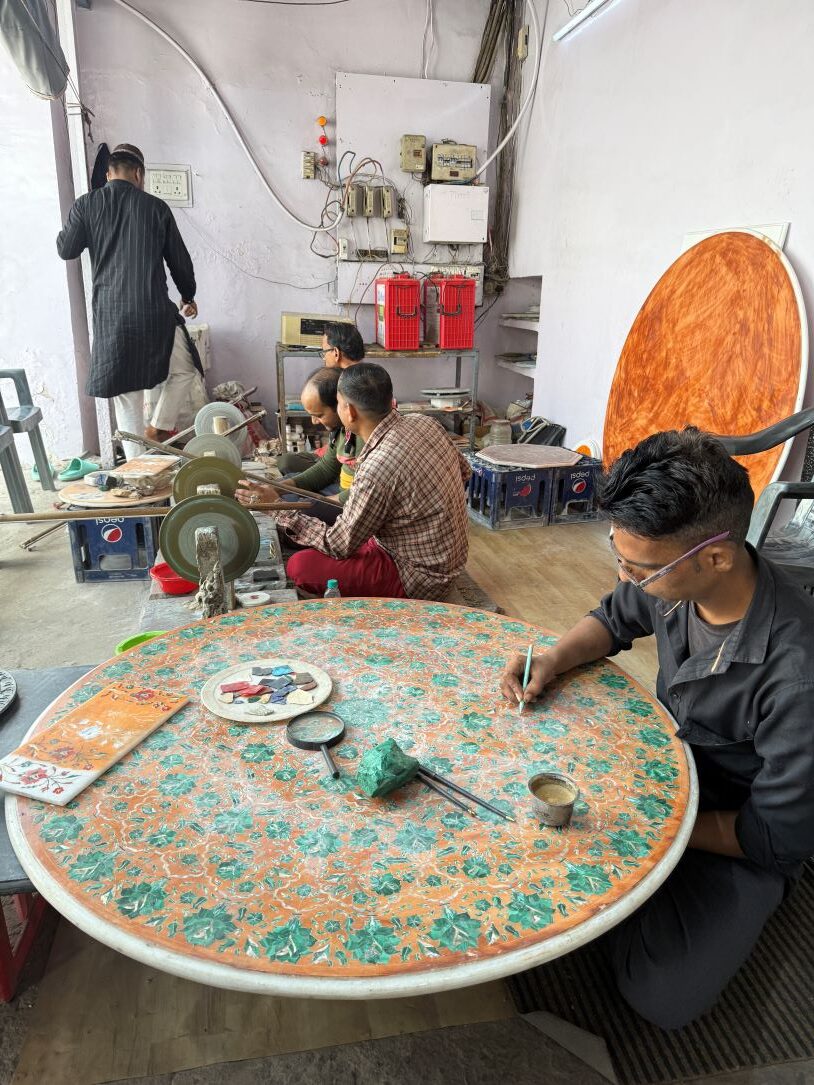
Interestingly, the tomb is often referred to as the ‘Baby Taj‘ due to its design similarities with the Taj Mahal. Since it was built slightly earlier, locals have even suggested that it may have been its inspiration. Others call the structure a ‘jewellery box’ because of the numerous gemstones inside the tomb chamber. Regardless of these pet names, it is a stunning edifice made entirely of white marble with a hint of pink along the interior walls. In addition to the intricate latticework, the elaborate floral and tile designs were created using an inlay technique called ‘pietra dura,’ which is an intricate art of cutting and polishing stones to fit into chiselled grooves in the marble.
Taj Mahal
In our opinion, the Taj Mahal (a UNESCO World Heritage Site) ranks among the most beautiful mausoleums in the world and is an absolute wonder of ancient architecture. It was constructed as a symbol of love by Mughal ruler Shah Jahan in memory of his favourite of three wives, Mumtaz Mahal, who died in 1631 while giving birth to their 14th child. Although their marriage was arranged when they were both very young, they developed a deep love for one another in the years that followed. Her last wish was for a grand mausoleum to be built in Agra as her resting place. Thus, from 1631 to 1648, over 20,000 skilled craftsmen and 1,000 elephants were involved in its construction, transporting most of the building materials from Rajasthan. In reality, it took 22 years to complete the mausoleum, during which the royal treasury was depleted multiple times, and widespread famines were common, as much of the grain and livestock were diverted to Agra to feed the workers.
The mausoleum showcases Indo-Islamic architecture, characterised by perfect symmetry. Constructed entirely of white marble, both the interior and exterior feature the art of pietra dura, where semi-precious jewels were cut into embedded grooves to create intricate floral images. Remarkably, the four minaret towers tilt outward by 2 degrees, designed to fall away from the mausoleum in the event of an earthquake. Fortunately, if this were to happen today, they would not collapse into any of the staggering 7 million visitors each year.
Taj Mahal at Sunset from Mehtab Bagh
Our experience with the Taj Mahal began the day before, as we enjoyed a sunset view of the monument from Mehtab Bagh, a beautiful and tranquil green park located directly opposite this iconic structure, along the Yamuna River and far away from the crowds. With eager anticipation, we were not disappointed. The Taj Mahal is an incredible and awe-inspiring monument, showcasing sheer size and beauty. We were both mesmerised by the symmetrical precision of its parts, creating an epic moment that we will never forget.
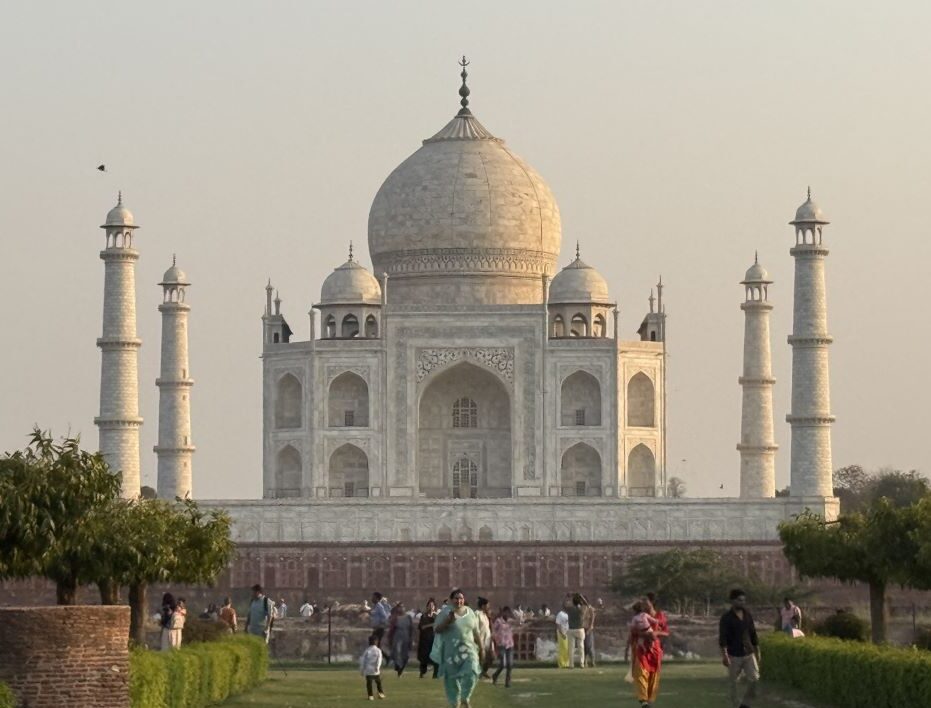
Apart from the magical sunset’s orange glow that spread across the Taj Mahal, we were equally fascinated by the foundations within Mehtab Bagh for what would have been a mirror image of the Taj Mahal, built in black marble to house the tomb of Emperor Shah Jahan. He envisioned an identical structure looking across the river at his wife, Mumtaz, in the white Taj. Sadly, or perhaps fittingly (depending on one’s perspective), before Emperor Shah Jahan had a chance to start preparations, he was imprisoned by his son. This may have been partly due to the recent costly recovery of the city’s famine or concerns about the excessive cost of black marble compared to the more affordable white marble!
Taj Mahal At Sunrise
Feeling blurry-eyed and wishing that we had never had that last beer the night before, our 5:30 am sunrise tour of the Taj Mahal was ready to depart to witness something extraordinarily special… and, to beat the crowds. Shortly after 6 a.m., when the gates opened, we arrived at the entrance to find hundreds of tourists queuing at the ticket counter. Luckily for us, one advantage of booking a tour guide is that we could go straight to the entrance without queuing for tickets! Security measures were understandably stringent. No sharp objects, hand sanitisers, deodorants, selfie sticks, power banks, tripods, video cameras, batteries, or even books were not allowed: anything that could potentially scratch or damage the structures. Strangely, smartphones were seen as a safe object!
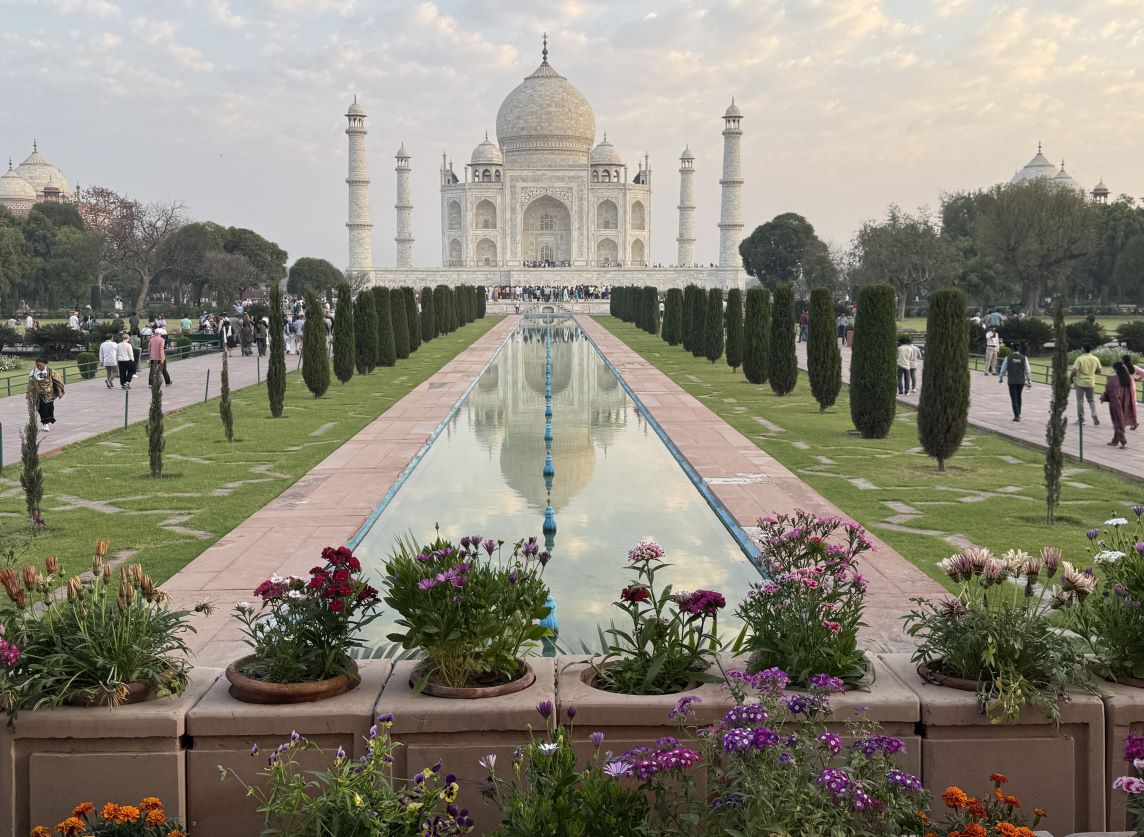
Our local guide, Abdul, took us through the main north gate entrance and began sharing dates and events. We quickly asked him to slow down and focus less on the minor details, as it was early and our brains hadn’t fully woken up yet! After passing the impressive red sandstone buildings that once served as accommodations, we had the breathtaking experience of coming face-to-face with the iconic Taj Mahal. Even more vivid than at sunset, the rising sun cast a beautiful pink glow on the white towers and the dome of the tomb. The entire structure appeared stunning and immaculately clean, its whiteness evoking a sense of purity.
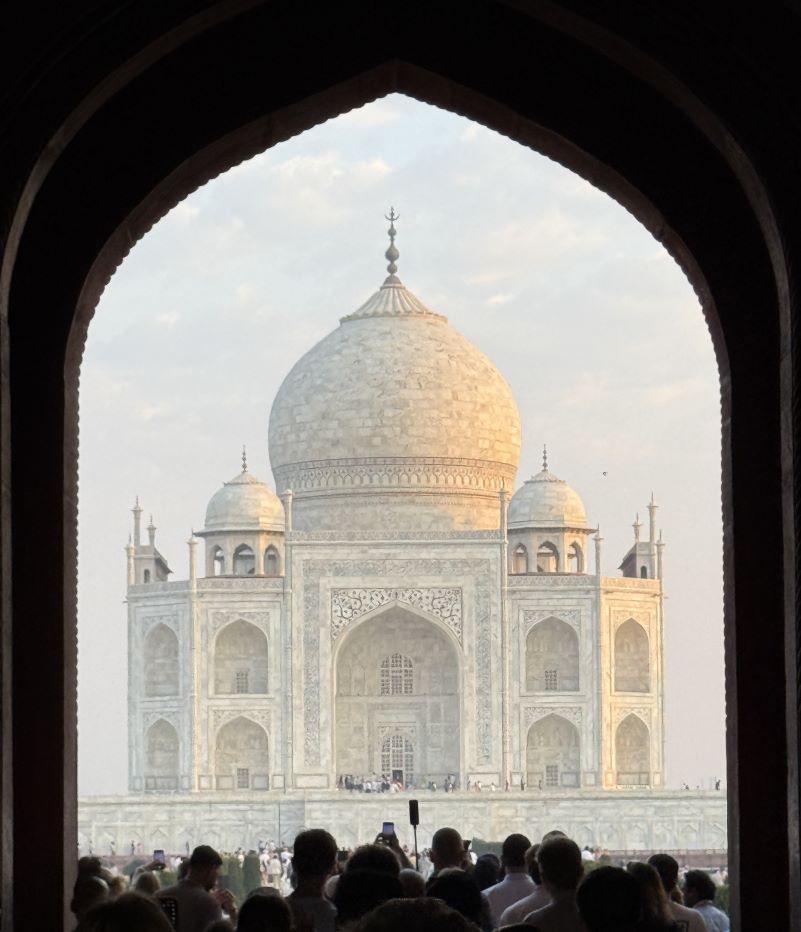
As we walked down the fountain-filled central path, we were captivated by the extraordinary beauty of the four large symmetrical lush green lawns, which were intersected by four water channels symbolising the rivers of life: milk, water, wine, and honey. Flanking the Taj Mahal were two huge red sandstone buildings, one a mosque and the other a former guest house, which further highlighted the whiteness of the mausoleum.
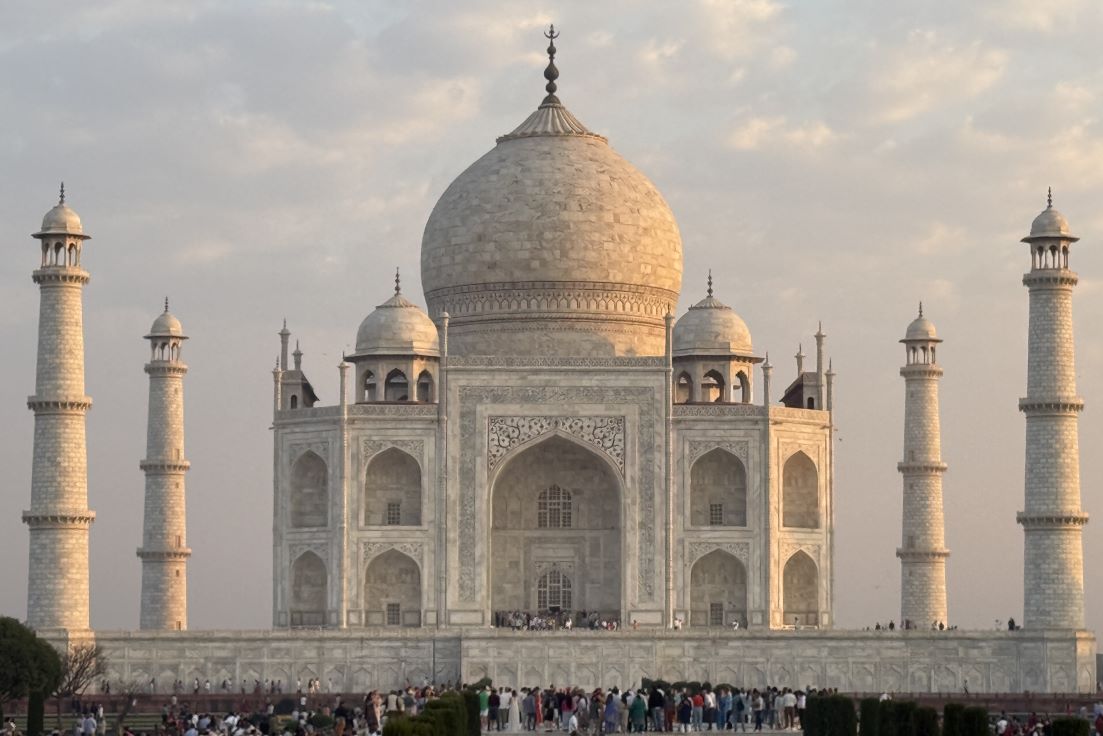
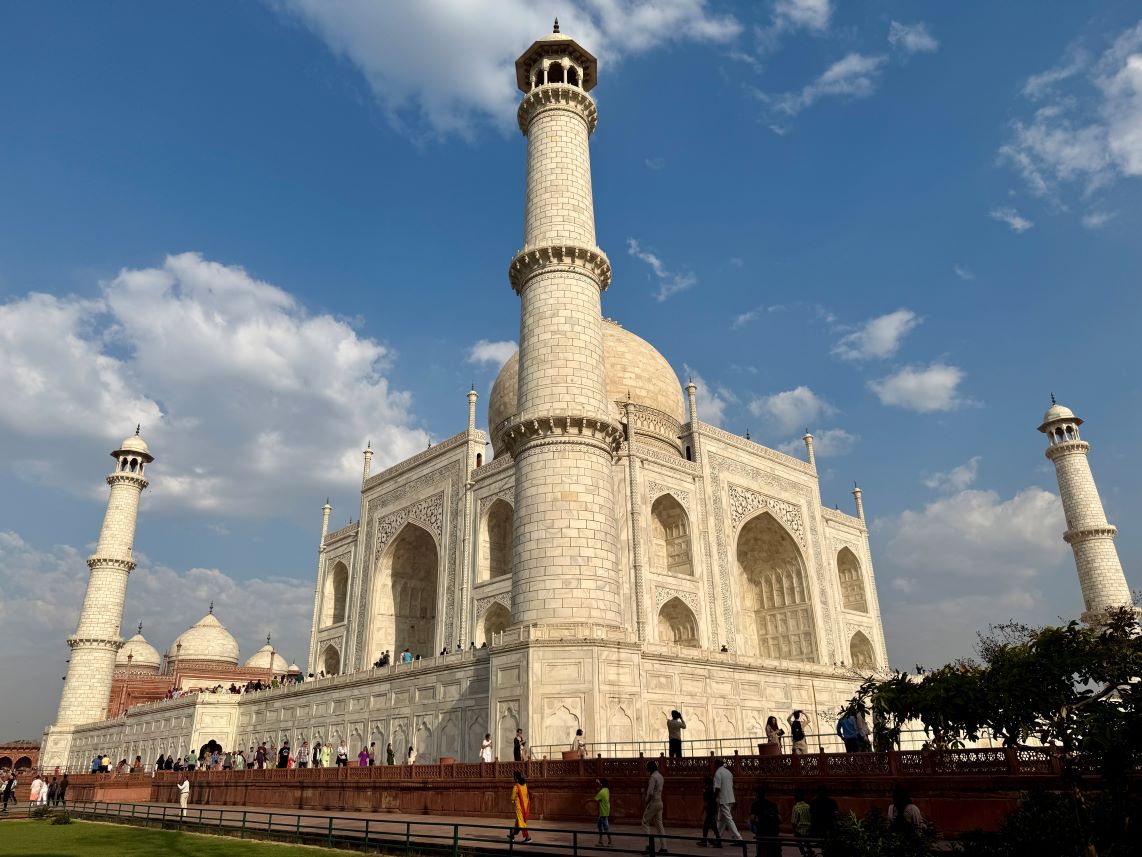
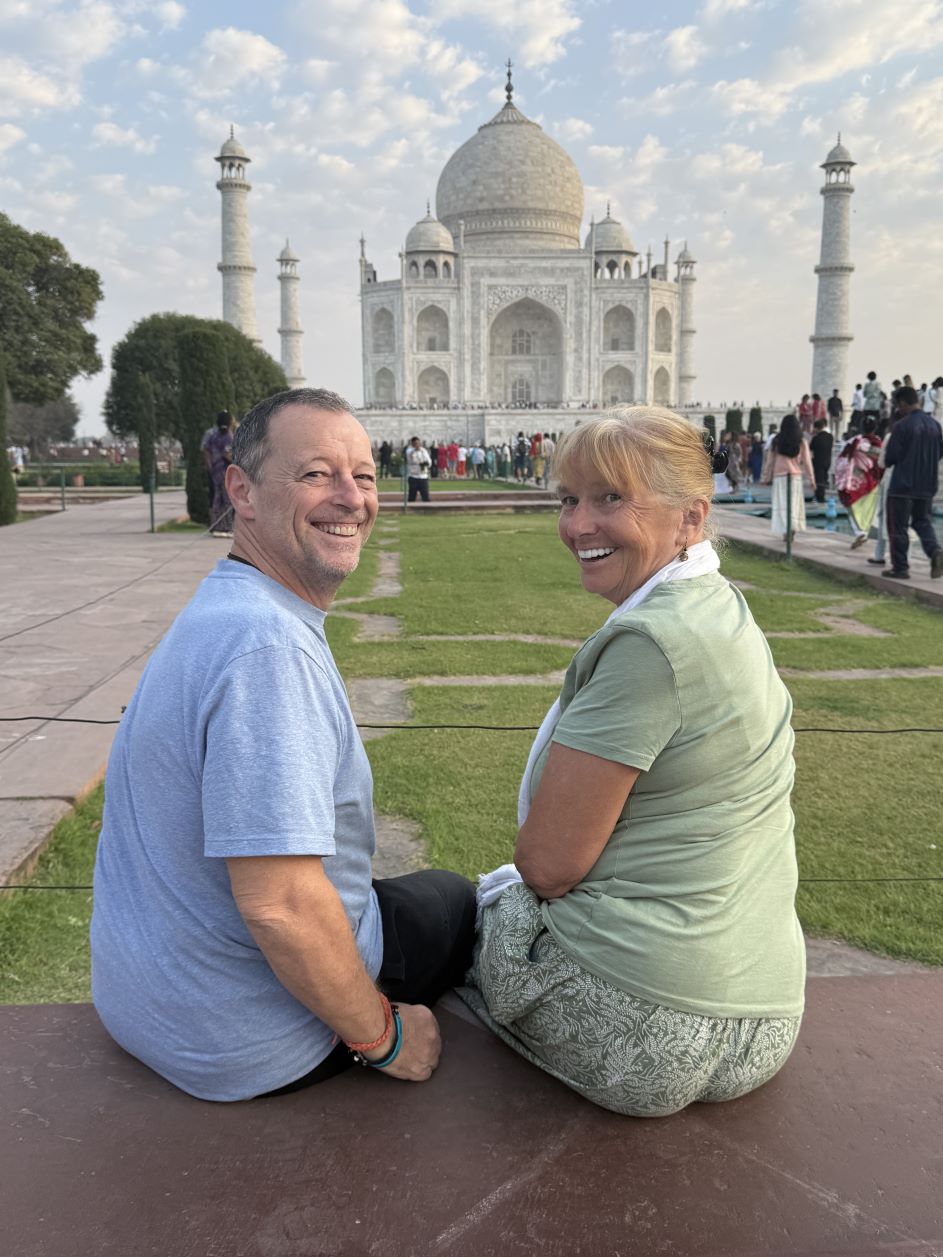
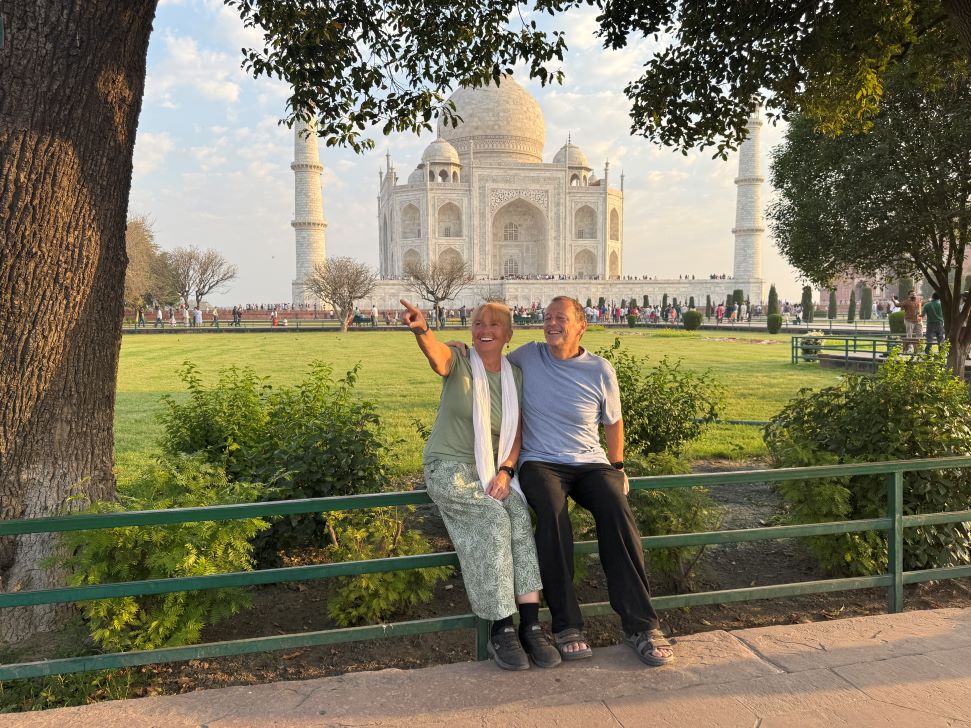
The famous ‘Diana Bench,’ where Princess Diana sat in solitude in 1992, seemed to be in the wrong location as it appeared too far away. Nevertheless, there were queues of families trying to recreate the iconic photo on a white bench, now placed on a raised platform. Regardless, it was too early to argue with our guide, so instead of waiting in line, he found us an equally appealing bench that has now been unofficially named ‘Lorna’s Bench.’
Taj Mahal’s Upper Terrace
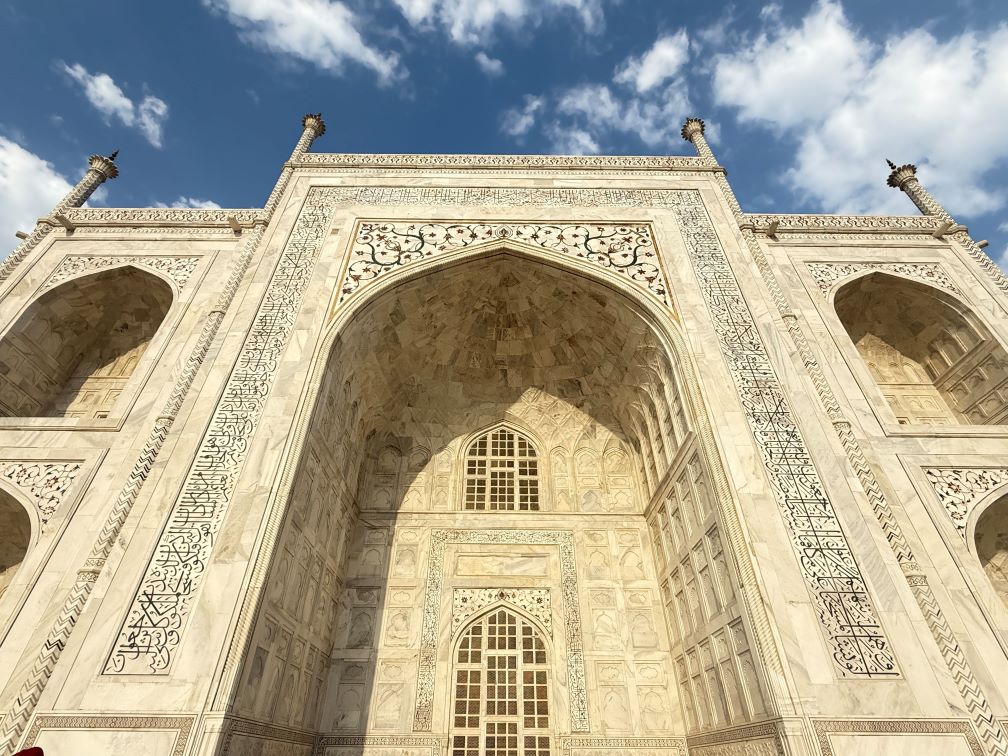
Equipped with protective shoe covers, we made our way to the Upper Terrace to get a closer look at the tomb. After a short queue, we were able to appreciate the Taj’s beauty, including the hundreds of semi-precious stones intricately carved into the exterior marble. The entrance to the chamber featured verses from the Qu’ran, elegantly inscribed in Arabic calligraphy, which gradually increased in size towards the top, creating the illusion of uniformity when viewed from the ground.
Inside Taj Mahal’s Tomb Chamber
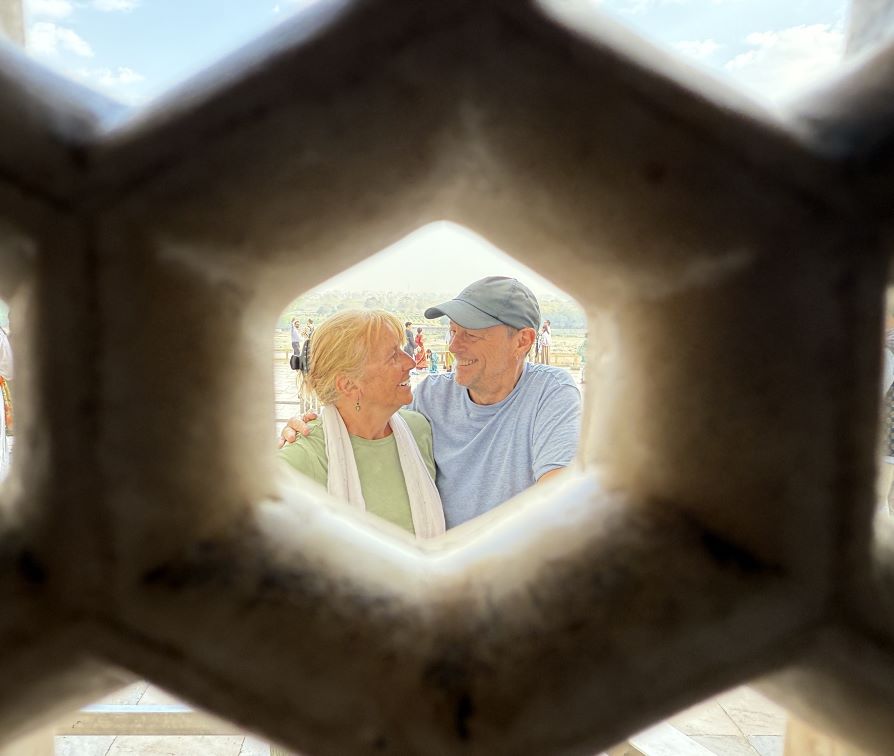
As we entered the tomb chamber, we were surrounded by white marble walls, a gorgeous, perfumed smell of the burning incense. We encircled the false tombs of Mumtaz Mahal and Emperor Shah Jahan, where the actual tombs are hidden from view beneath the structure. Surrounding the cenotaphs were stunning lattice walls that allowed patterned light to illuminate the mausoleum. These walls were adorned with jewelled floral patterns, particularly featuring jasmine (symbolising sensuality) and lotus (representing divinity). Abdul, our guide, demonstrated the beauty of the jewels by shining a light, and we were stunned by their colourful translucency and shine, all of which contribute towards the tomb’s radiance.
Frustrated at the Gorgeous Agra Fort
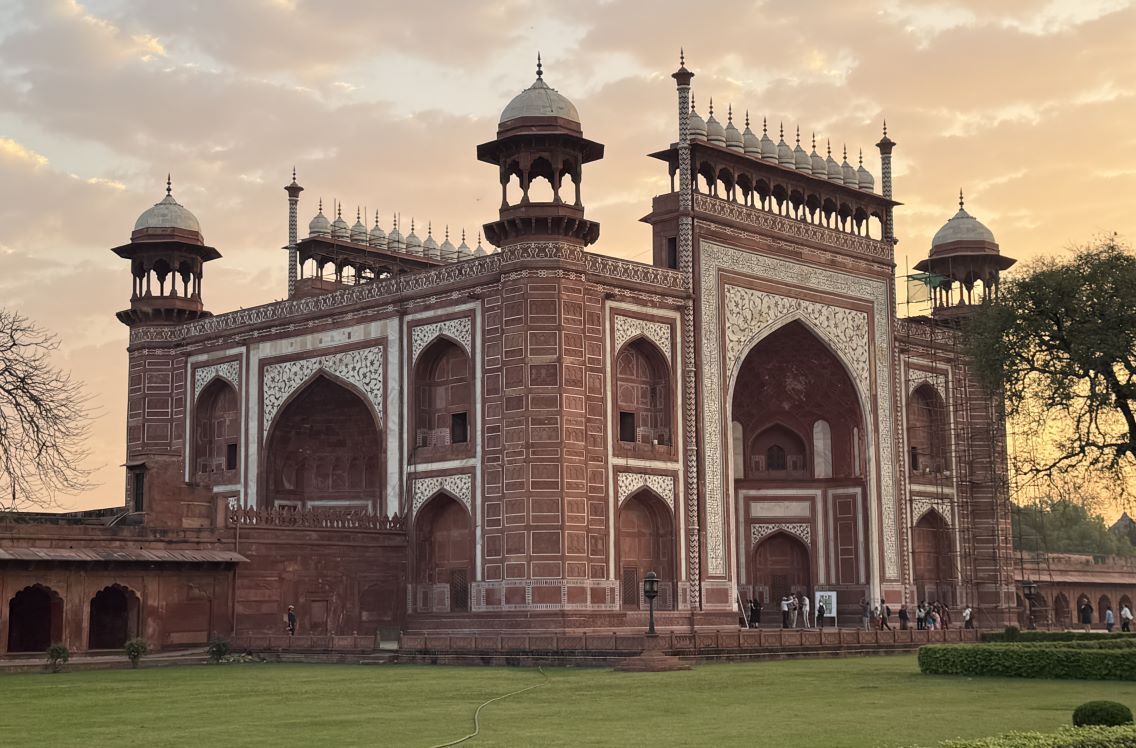
As part of our sunrise tour, we also visited Agra Fort, another UNESCO World Heritage Site. Built in 1565, it initially served as a military base, but was later converted into a royal palace for a succession of Mughal emperors until they moved the capital from Agra to the Red Fort in Delhi. One notable historical event at the fort was the imprisonment of Mughal Emperor Shah Jahan, who commissioned the building of the Taj Mahal, by his son Aurangzeb, who overthrew him in 1858 after a bloody coup. Shah Jahan could only gaze upon his beloved’s tomb from Agra Fort, but tragically, he never set foot inside it.
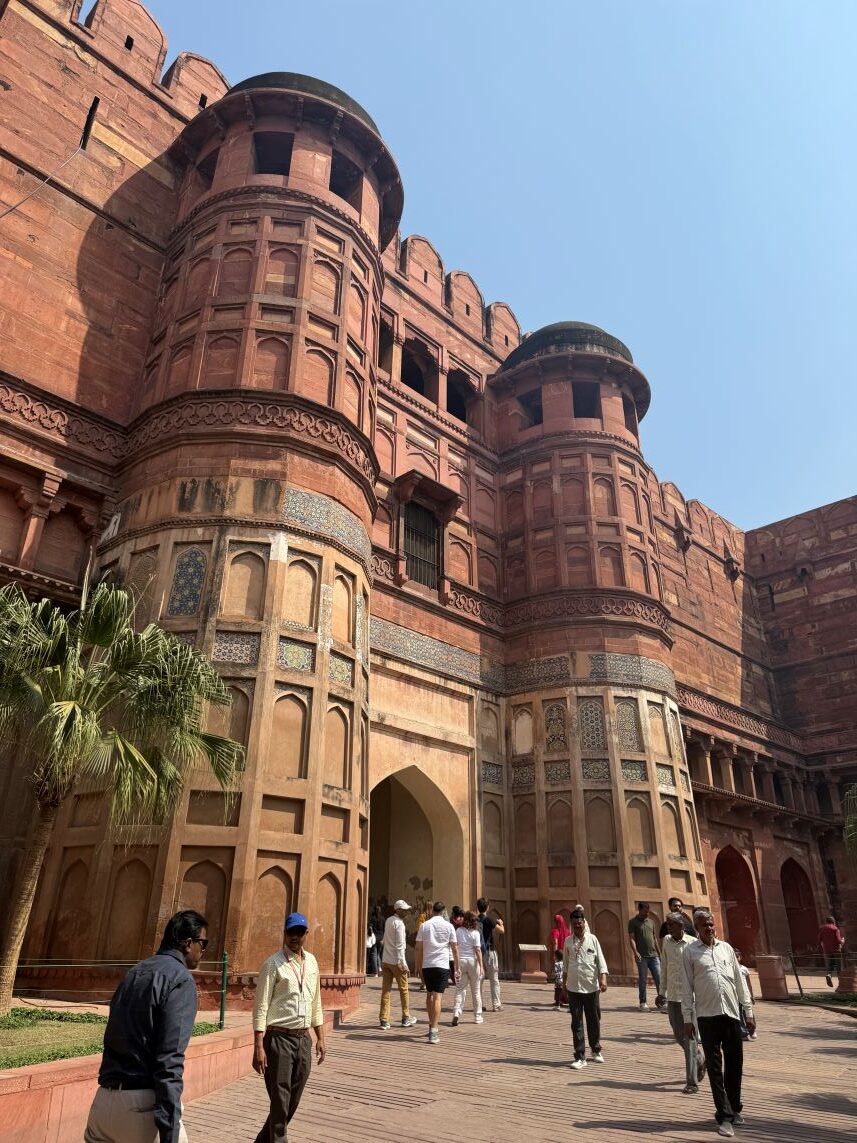
Similar to the Red Fort in Delhi, Agra Fort shares structural characteristics, both designed like a walled city within a city. Agra Fort is a massive complex made from red sandstone and marble, surrounded by a moat on three sides and a river on the fourth. The double-thick sandstone walls, measuring 20 meters, made it almost impenetrable. Inside the fort, we explored a maze of palaces, courtyards, halls, and gardens, with each emperor preserving the structures of his predecessors while building his own. Our favourite structures included the beautiful Jahangiri Palace, the expansive courtyard and gardens of Anguri Bagh, and the decorative audience halls of Diwan-i-Khas and Diwan-i-Am. Unfortunately, many original buildings were destroyed by the British in the 19th century to make room for army barracks, similar to what happened at the Fort in Delhi.
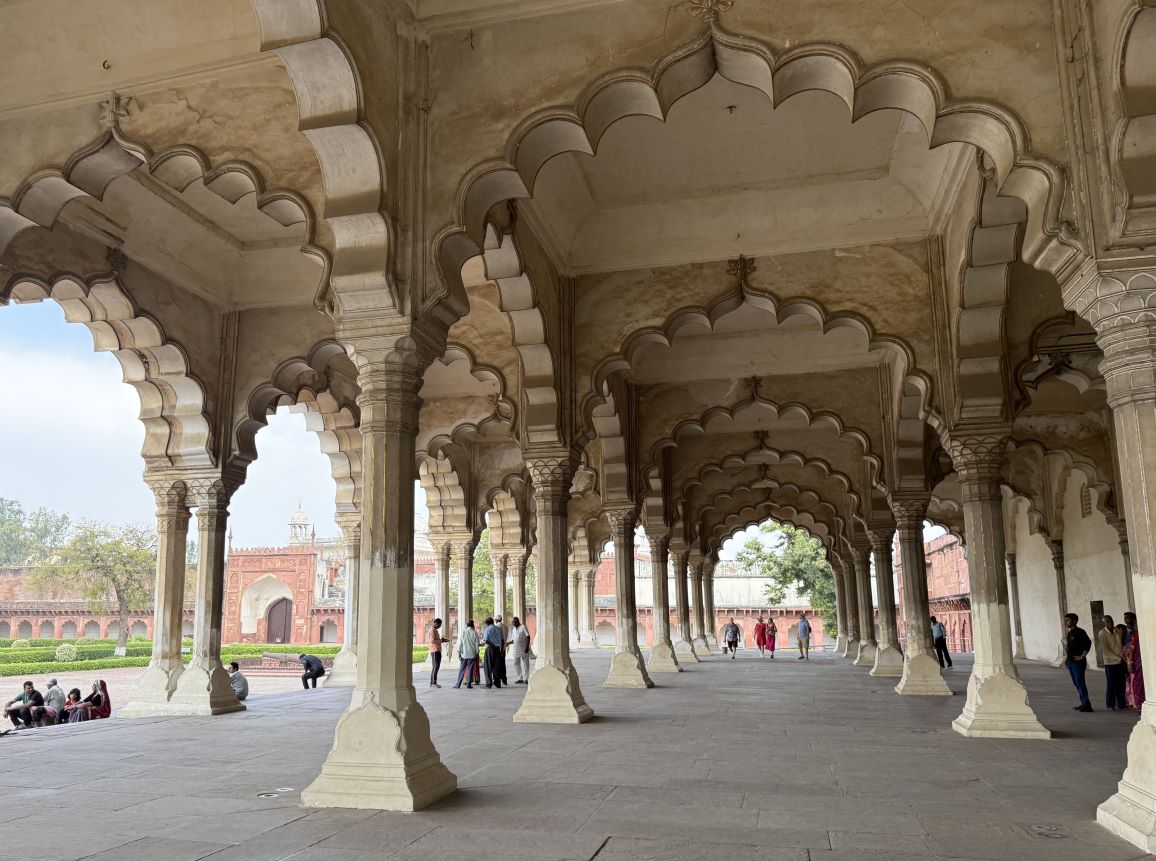
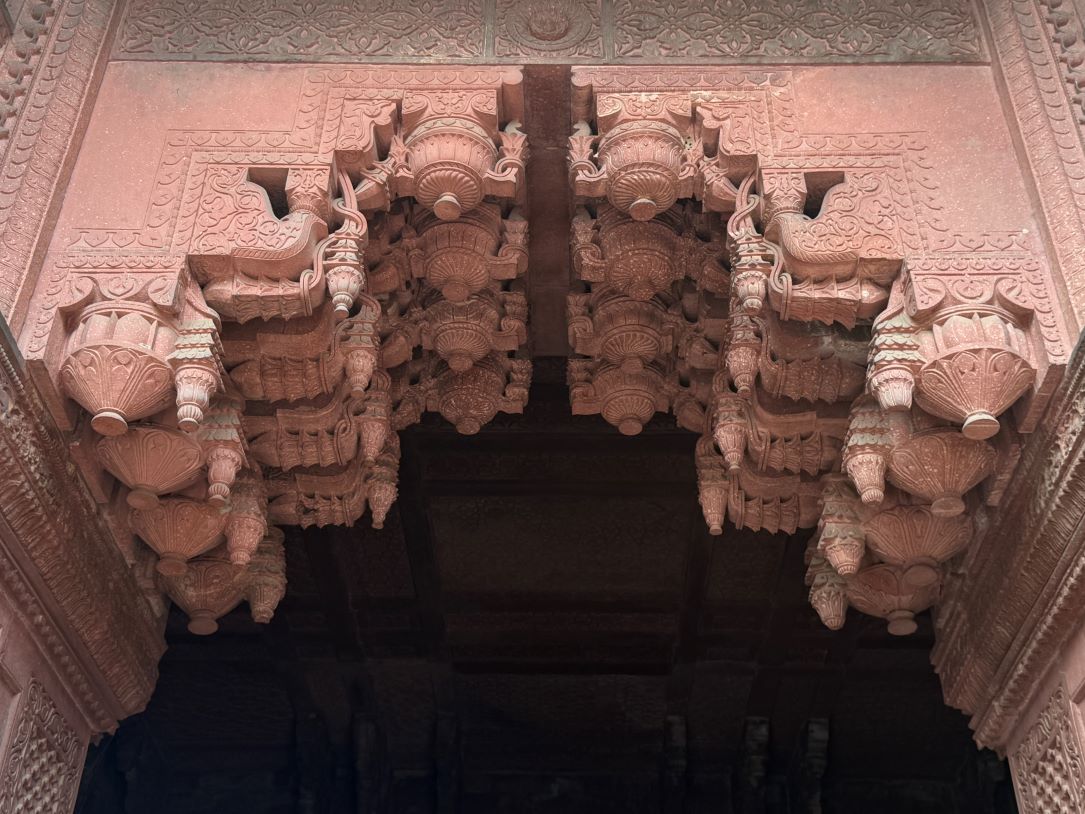
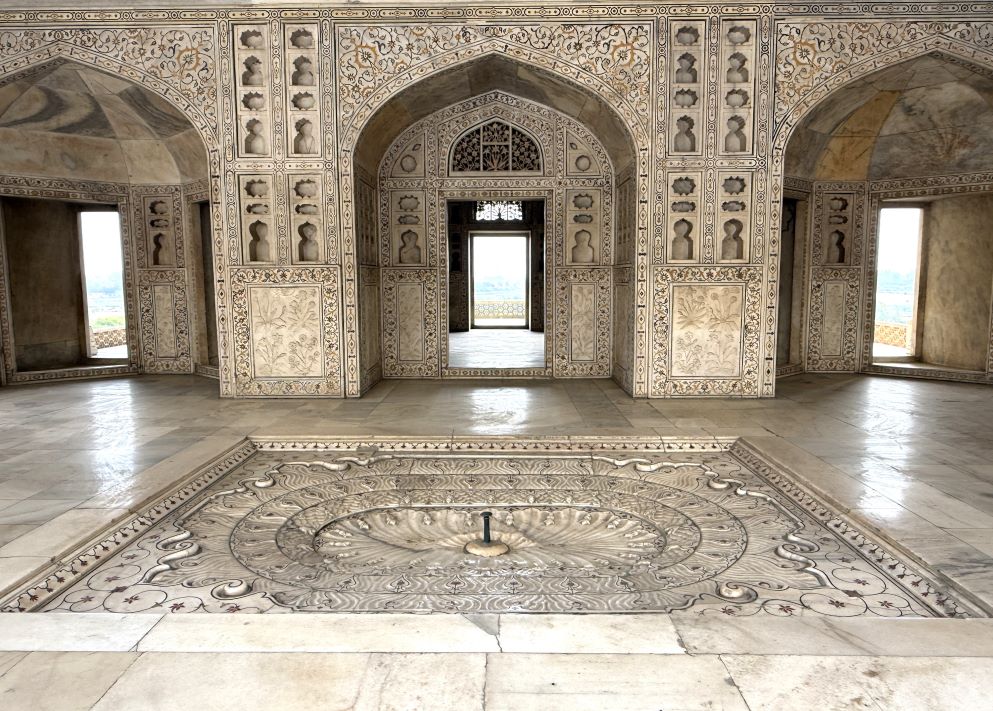
After reflecting on our experiences, we appreciated the grandeur of the Taj Mahal and Agra Fort, though it came with mixed feelings. Our guide, Abdul, was attentive and captured some memorable photos for us. However, waking up at 5:00 AM and being herded through the two sights alongside thousands of other sunrise tourists, while being bombarded with dates and figures for six hours, was quite exhausting. It would have been more enjoyable to visit the fort at our own pace one day and then schedule a separate sunrise tour of the Taj Mahal on another day.
Other attractions we visited in Agra
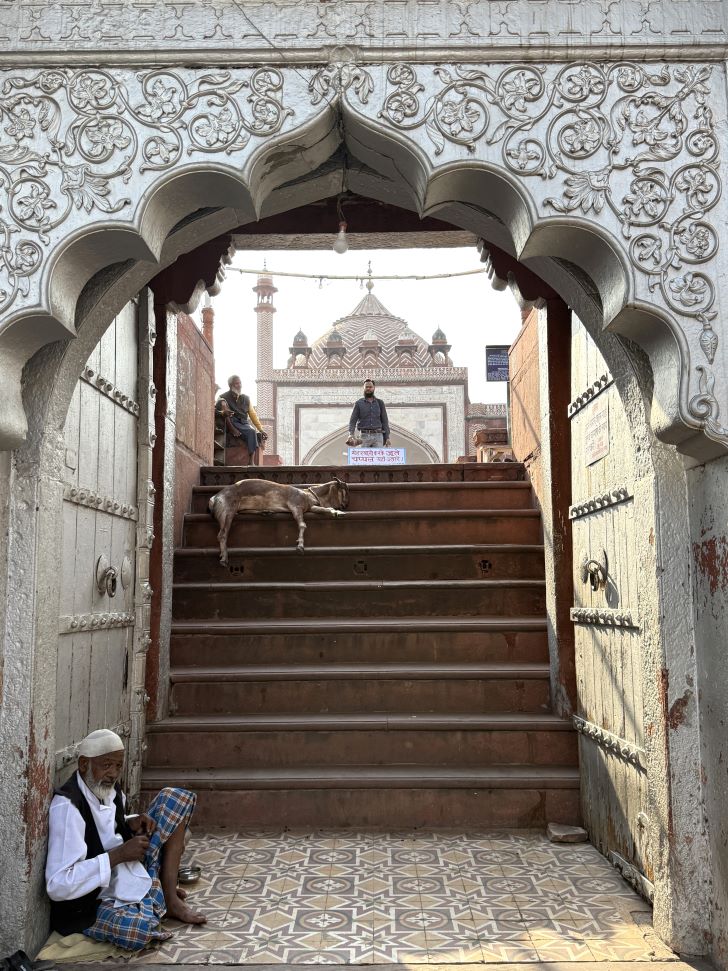
On Friday, which is the day when the Taj Mahal is closed, we took the opportunity to explore some of Agra’s less touristy attractions. To begin, we visited the Jama Masjid in the Old Town, another architectural masterpiece commissioned by Emperor Shah Jahan. Like the Jama Masjid in Delhi, it is constructed from red sandstone and features white marble decorations. The mosque had a spacious courtyard surrounded by a cloistered arcade, a series of domes and minarets, and three large entrance gates beautifully adorned with intricate calligraphy and symmetrical patterns.
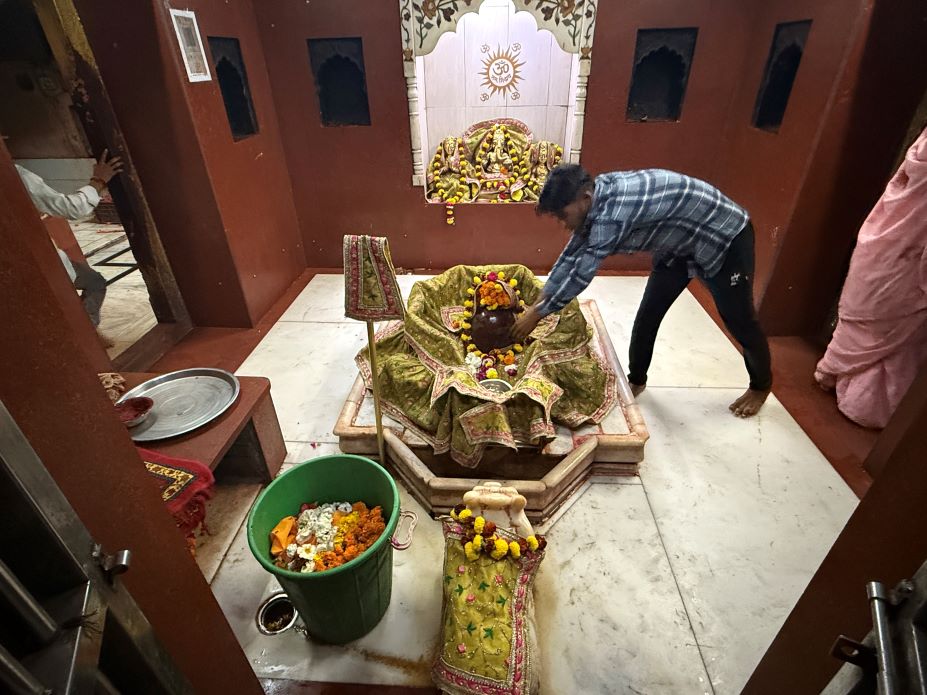
From Jama Masjid, we wandered through a maze of bustling streets filled with thousands of market shops, traditional street food stalls, and various historic and religious structures. Two particular sites stood out: the dark and foreboding Mankameshwar Mandir, with its silver shivling hidden deep within the sanctum, and Rawatpara, the wholesale spice market, where we found ourselves sneezing uncontrollably from the dust created by the hundreds of sacks of chilli peppers. Obviously, we had not learnt any lessons after similar experiences in Delhi’s Chandni Chowk spice market.
The Taj Nature Walk was a pleasant place to spend an hour or two wandering along undulating semi-paved pathways through an urban, lush green open woodland. There was not a lot of wildlife to see, except plenty of butterflies, a few squirrels and a couple of green parrots. However, there are a few peacocks, and when startled, they certainly fly fast and low! We also came across a few unobstructed views of the Taj Mahal, which was an added surprise.
If we had more time, we would have visited:
The following places are all easy day trips from Agra or offer an alternative base for trips into Agra.
- Fatehpur Sikri (see below)
- Sikandra (10 km away, with a beautiful tomb of Akbar the Great, rich in elaborate and colourful decorations)
- Mathura and Vrindavan (60 km north of Agra; Mathura is the birthplace of Krishna, with numerous events in Krishna’s life occurring in nearby Vrindavan. Both locations are filled with hundreds of temples lining the alleyways and ghats).
Fatehpur Sikri
We didn’t visit the UNESCO World Heritage site of Fatehpur Sikri on this trip, but Terry, who has been there twice before, would strongly recommend it. Fatehpur Sikri is an ancient city built in the 16th century by Emperor Akbar of the Mughal Empire. Unfortunately, it was abandoned within 15 years due to a lack of water and poor sanitary conditions, resulting in a ghost town for hundreds of years. Today, however, it offers an impressive set of ruins to explore.
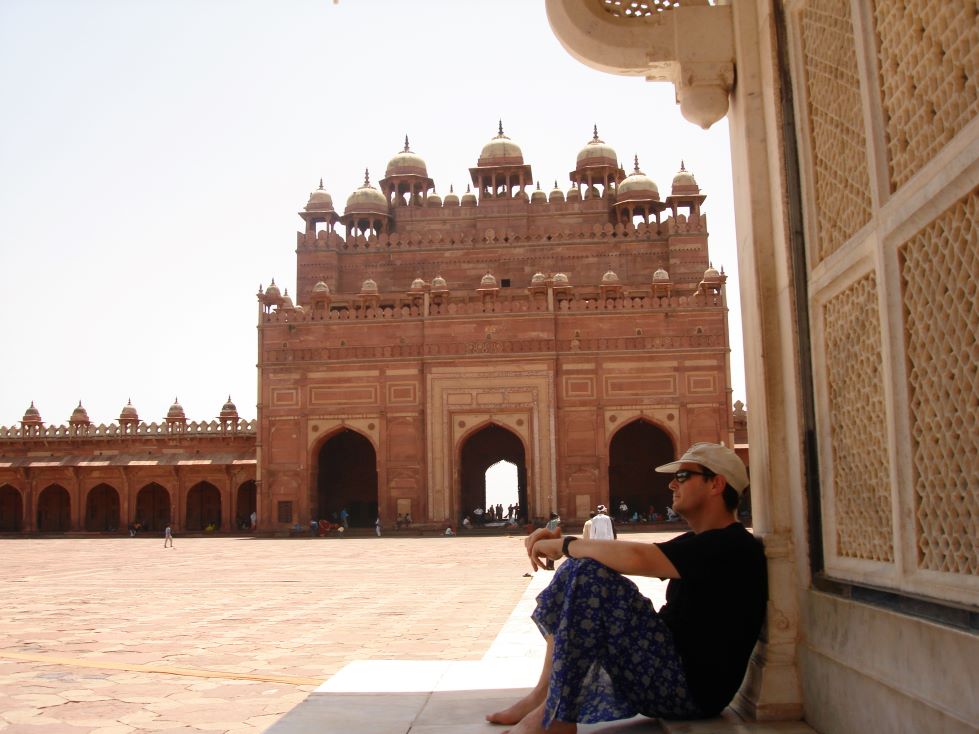
The main structures showcase Persian and Islamic architectural influences and are constructed from various shades of red sandstone. The mausoleums are adorned with brightly colored floral murals and canopies made of mother-of-pearl. Among the remarkable pieces of engineering is the magnificent Diwan-i-Khas (Hall of Private Audience), which features decorative stone columns that flare out to support a flat-topped plinth ceiling. Additionally, the enormous Buland Darwaza, standing at 54 meters high, serves as the entrance to the Jama Masjid, considered the most spectacular entrance gate in all of India.
Accommodation in Agra
Agra offers a variety of accommodations to suit all budgets. While some travellers choose to stay outside of Agra in the quieter ancient towns of Fatehpur Sikri or Mathura, we decided to stay in the centre, closer to the train stations and for easy access to our sunrise tour of the Taj Mahal. We opted for Alibaba’s Indiana Homestay, located about 1.5 km from the main sights. The family were warm and welcoming, attentive to our needs, and the combination of a stunning rooftop terrace and a truly delicious breakfast made our stay exceptional.
Eating in Agra
There is a wide range of eateries throughout the city, although we were surprised to see that there were no Western/European restaurant chains except the independent pizza establishments that seem to pop up on every street corner. Generally, dining prices were slightly higher compared to other cities, with the expected overpriced rooftop restaurants closer to the Taj Mahal. Two places we recommend are Tea’se Me on Fatehabad Road, which has an extensive menu and a charming yet dimly lit rooftop (thank goodness for our smartphone torches!), and the popular family-friendly GMB Gopika on Subrata Road, where we enjoyed the best honey chilli potatoes of our entire trip to India.
Travellingterry Agra Tips
- The Taj Mahal is best experienced with a private tour. Guides can navigate queues more efficiently, and they are skilled photographers who know the best spots to capture photos. They are also assertive enough to ask other tourists to move while taking pictures.
- With the Taj Mahal behind, the best photos are taken with brightly coloured clothes rather than white.
- The Taj Mahal is closed on Fridays.
- According to our guide, it’s possible to visit the Taj Mahal at night, at the same cost as during the day, but limited to only 400 visitors.
- During Ramadan, the Taj Mahal suspends its sound and light show as well as night-time viewings.
- The ticket office at Mehtab Bagh closes 30 minutes before sunset.
- Some useful websites: the Archaeological Survey of India, which offers discounts if tickets are booked online, the Taj Mahal, which also provides information on prices, opening and closing times and historical backgrounds for other sites, including Agra Fort and Fatehpur Sikri, and 12Go and IRCTC are for train travel.
Onward travel: Train from Agra to Gwalior (AC 1st Class Sleeper)
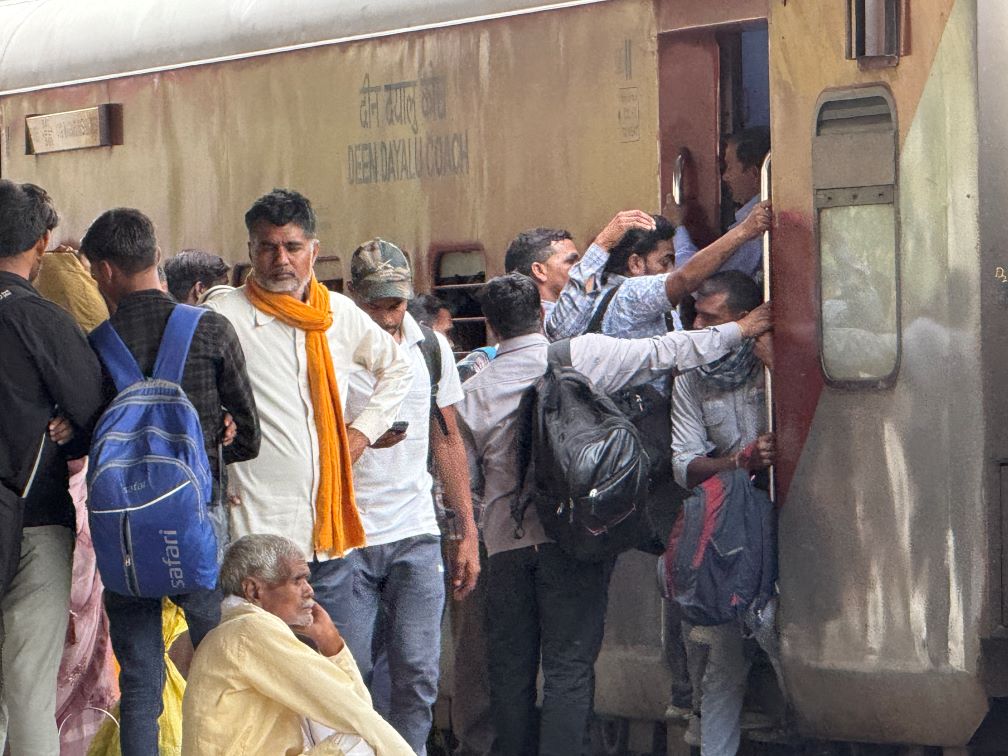
On our last day in Agra, we finished our sunrise tour of the Taj Mahal and Agra Fort by midday and spent some time relaxing on the rooftop of our accommodation until our 3:15 PM train to Gwalior (which arrived at 5:00 PM). We travelled the short 2-hour journey in a 1st class sleeper carriage since there were no available chair carriages on this train. Unfortunately, it was somewhat uncomfortable to find the previous occupants had left their bed sheets draped over our bunks, which we had to discard ourselves before settling in!